

 Русский

 June 4, 2026
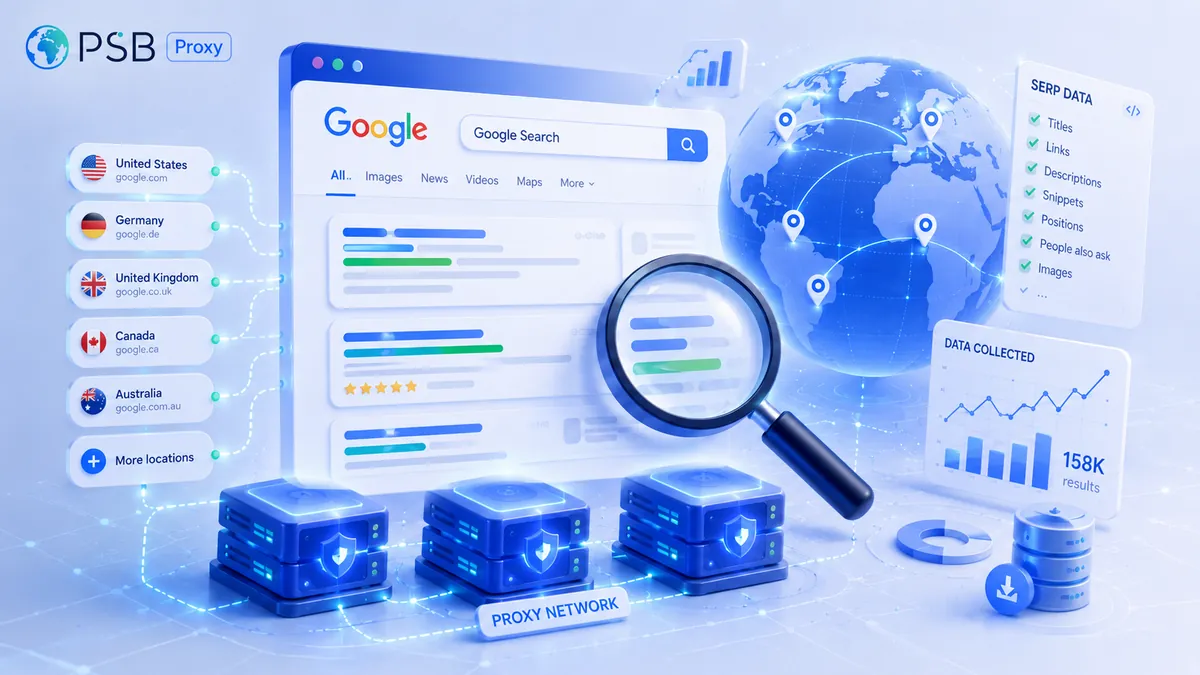
Parsing Google search results is central to most search marketing, SEO analytics, and competitor monitoring tasks. Collecting data on website rankings and analyzing ads allows businesses to respond quickly to algorithm changes and identify growth opportunities. However, Google has an advanced system to protect against automated queries. Attempts to collect data directly or using low-quality proxies quickly result in CAPTCHAs, errors, or complete IP blocking. Therefore, it is important to know how to properly parse Google search results to minimize the risk of restrictions from the search engine.
Which Google Search tasks have different proxy requirements
Depending on the tasks in Google Search, the technical requirements for proxy servers may vary:
- Mass rank tracking. For tracking rankings, high query processing speed and minimal cost per data unit are important.
- Local search results by city and country. Google search results are heavily dependent on the user’s location. Accurate tracking of local SEO requires proxies with detailed targeting capabilities.
- Mobile SERP. Mobile search results differ from desktop results in most cases. Parsing mobile results requires proxies that match the mobile context, the required GEO, and the network type.
- Desktop SERP. Standard collection of desktop search results, for which stable IPs, correct GEO, language, and regional context are important.
- Competitive monitoring by clusters. This involves an in-depth analysis of a limited number of competitor websites. This involves complex queries and requires consistency in IP, region, and browser environment.
- Spot SEO checks. In this case, a manual or semi-automated audit of individual pages or real-time search results is required.
- Regular crawling of a large semantic core. A continuous or periodic process of collecting data on a large number of queries is carried out.
Thus, proxies for SEO tasks should be selected based on the scenario: mass rank tracking, local search results, mobile SERPs, and spot checks require different configurations. This helps reduce the risk of being blocked and achieve the desired results.
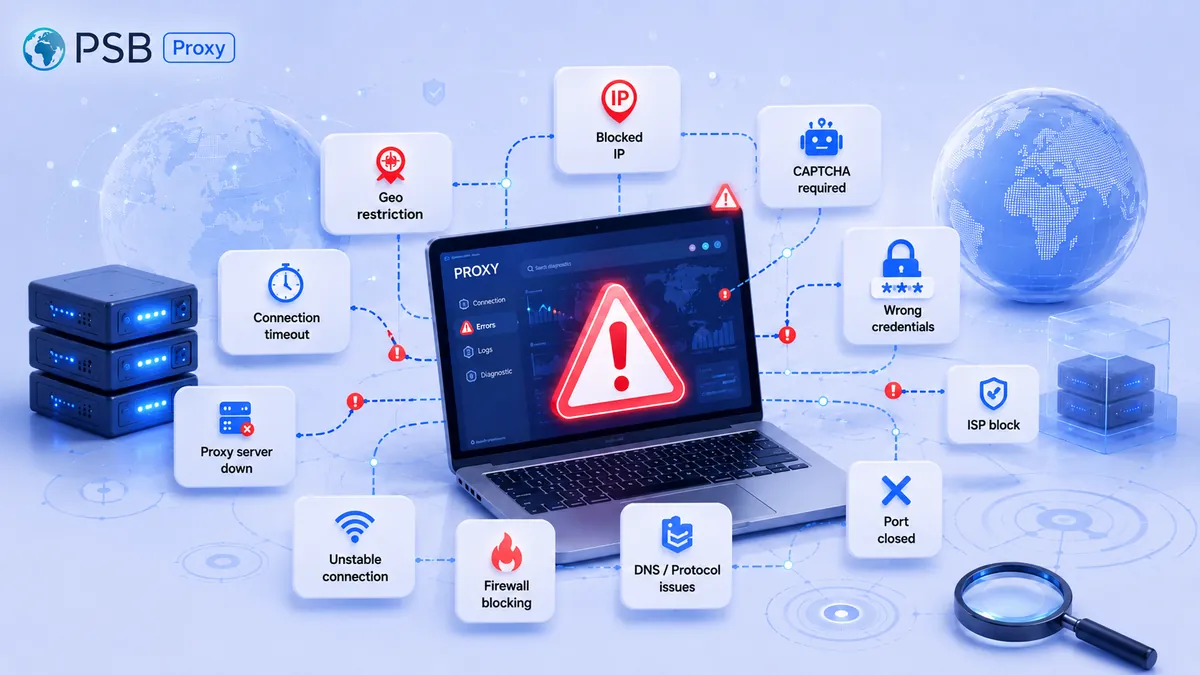
What Most Often Triggers CAPTCHA, 429 Errors, and Rate Limits in Google Search
Google’s algorithms monitor for signs of unnatural user activity. CAPTCHA, 429 (Too Many Requests) errors, and rate limits most often occur when the following triggers are detected:
- requests from ranges associated with hosting providers and data centers;
- an abnormal frequency of requests from a single IP address;
- mismatched network fingerprints;
- lack of cookies and session history;
- use of complex search operators.
Therefore, Google parsing should be conducted in a way that solves marketing objectives while minimizing the risk of triggers that lead to CAPTCHA, 429 errors, and other restrictions.
Before launching SERP monitoring, it is important to consider the platform’s rules, acceptable query frequency, and legal restrictions. Proxies help distribute the load, check local search results, and build a stable data collection infrastructure, but they do not override Google’s requirements and should not be used for aggressive automated access.
Which parameters are most important when choosing proxies for Google SERP
When selecting a proxy solution, you need to evaluate several key parameters:
- GEO. For high-quality parsing, proxies must support the selection of geo-specific regions. The more detailed the targeting, the more accurate the collected data will be.
- Proxy type. The distinction between data center, residential, and mobile proxies determines Google’s level of trust and the appropriate use case.
- Search results context: mobile or desktop. It is important that the address pool used matches the scenario being tested. For example, when parsing mobile search results, traffic must go through mobile IP addresses.
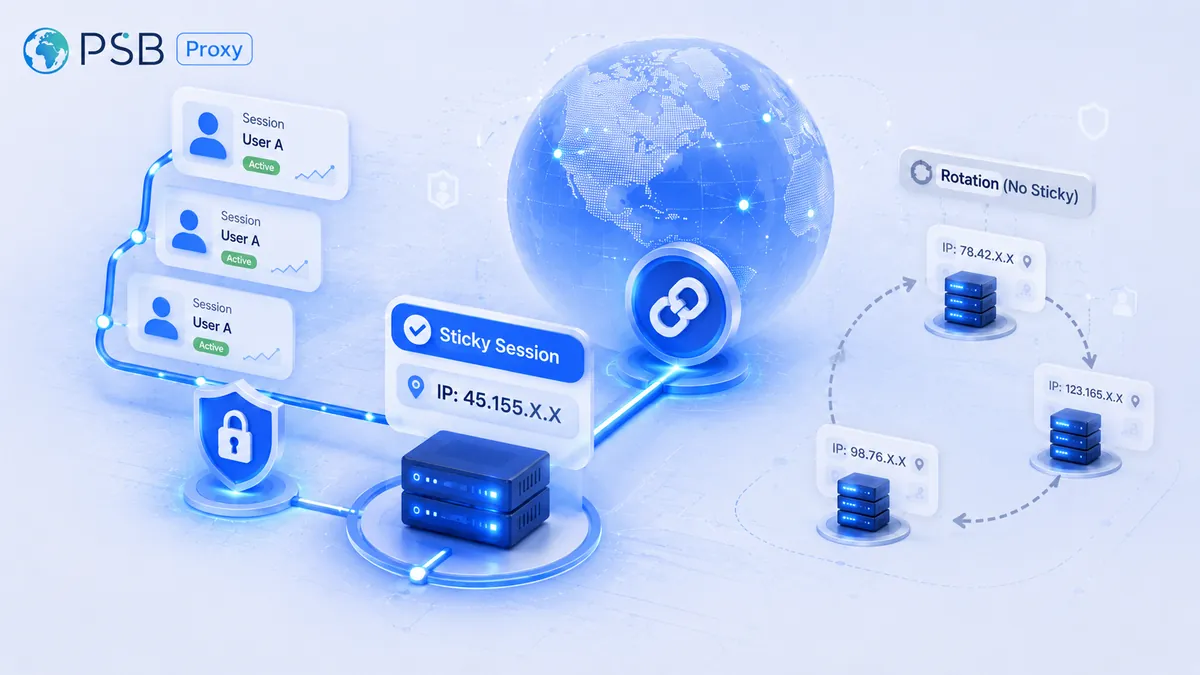
- Rotation or sticky session. On-demand rotation is necessary for bulk data collection, where each new search query must originate from a new IP address. In contrast, a sticky session maintains a single IP address for a specified period, which is required for the sequential collection of multi-page results or a single working session.
- Scale of requests. The scale of requests is also an important parameter. The size of the provider’s address pool is crucial. If the pool is small, the IP addresses will quickly exhaust Google’s trust limits, leading to an increase in errors and a drop in collection speed.
When Data Center Proxies Are Suitable for Google Search
Data center proxies are the most cost-effective option, offering high speed and high bandwidth. However, they generally have a lower reputation in the eyes of search engines than residential and mobile proxies. For direct Google Search scraping, data center proxies are more suitable for testing, low-intensity tasks, quick SEO checks, and specific technical tasks.
During large-scale SERP monitoring, they often trigger CAPTCHAs, 429 errors, and rate limits, so this type of proxy is rarely the primary choice. They can be used at the start of a project to test hypotheses and for tasks with extremely low intensity and long random delays between requests.
Why residential proxies are the best choice for SERP monitoring
Residential proxies are provided by real internet service providers for home users. To Google, such requests typically appear closer to the traffic of regular users connected to home Wi-Fi. The main advantages of choosing residential proxies for SERP monitoring include:
- search engines are more lenient toward restrictions on large residential pools, since they are used by real users;
- the ability to collect search results with high accuracy and analyze local ads;
- the ability to automatically change the IP address with each request, which allows you to distribute the load across a large pool of addresses and reduce the risk of restrictions when maintaining a proper request frequency.
In addition, SERP pages in HTML or JSON format are lightweight, so you pay only for the traffic you actually use. This makes residential proxies a cost-effective solution for large-scale projects.
Are mobile proxies suitable for Google Search?
Mobile proxies use mobile carriers’ IP addresses, and thousands of mobile users can access the internet under the same external IP address. Such IPs are often more resilient to strict restrictions because they are used through the operators’ address pools. However, this does not guarantee the absence of CAPTCHAs or 429 errors: with a high request frequency, poorly configured headers, or suspicious behavior, restrictions are still possible.
We recommend using mobile proxies when you need to collect specific mobile search results, parse highly sensitive topics, or run complex search operators at high volumes.
Which Proxies to Choose for Different SERP Parsing Scenarios
To optimize your budget and ensure high stability, we recommend selecting a proxy type tailored to your specific workflow:
- Mass rank tracking across a large index. You can use residential proxies with rotation for each request. They provide maximum IP address diversification.
- Local search results by country and city. It is best to choose residential proxies with precise geotargeting capabilities. This increases the accuracy of capturing exactly the search results that a user sees in the target location.
- Mobile SERP and mobile SEO checks. In this case, mobile proxies with rotation based on a timer or link are the optimal solution.
- Sensitive SERP clusters. Use mobile proxies or private residential pools with extended intervals between requests.
- Quick start with a limited budget. In this case, pay-per-traffic residential proxies are suitable. Initially, you’ll only need to pay for the data actually downloaded, allowing you to test the parser at minimal cost.
Choosing the optimal option will enable you to obtain effective marketing analytics within your budget.
What helps reduce the risk of being blocked during SERP parsing
Even high-quality proxies do not guarantee stability without proper parser configuration. To reduce the number of blocks and CAPTCHAs, we recommend:
- Ensure consistency between the network and browser environments. Modern security systems analyze network and browser characteristics. It is important that headers, language, region, device type, and network context do not contradict each other.
- Ensure header consistency. The language in the Accept-Language header must match the country of the proxy’s IP address.
- Handle redirects and errors correctly. If Google returns a 302 or 429 status code, the parser should acknowledge the error, reduce the request rate, and change the session or IP address, rather than attempting to endlessly repeat the request from the same proxy.
- Add random delays. Random pauses between requests reduce the risk of sudden spikes in traffic and make data collection more stable.
Most requests to Google from real users use the HTTP/2 or HTTP/3 protocols. Constant requests using the outdated HTTP/1.1 protocol may appear atypical and increase the risk of throttling.
How to Choose a Proxy Service for Google Search and SERP Monitoring
Selection Checklist
Before purchasing proxy access, you should evaluate the provider based on the following criteria:
- Availability of millions of active IP addresses;
- Support for most countries worldwide and the ability to select specific cities;
- Support for HTTP, HTTPS, and SOCKS5 protocols;
- Availability of pay-per-traffic plans;
- High network uptime;
- Ability to automate limit management and rotation;
- Support for fixed sessions and flexible IP switching;
- Clear statistics on traffic, errors, and success rates;
- Ability to test on a small sample before scaling.
How our PSB Proxy service helps with SERP monitoring
For SERP parsing, it’s important to choose a service not only based on the price per gigabyte, but also on manageability: you need different types of proxies, clear rotation, fixed sessions, GEO selection, traffic control, and the ability to scale the number of requests. We offer residential, mobile, and data center proxies, so you can build different configurations for various SEO scenarios: residential proxies for regular SERP monitoring and local search results, mobile proxies for mobile SERPs and sensitive clusters, and data center proxies for quick tests and low-intensity tasks. Rotation, fixed sessions, and traffic control in your personal account help you evaluate not only the cost of the proxy but also the value of a stable result.
Mistakes that cause SERP parsing to become unstable
Many developers make common mistakes when integrating proxies:
- using free public proxy lists;
- sessions that are too long without pauses;
- lack of traffic volume control;
- choosing a single proxy type for all tasks without considering GEO, mobile/desktop, and SERP cluster sensitivity;
- focusing only on price rather than success rate and the cost of a successful result;
- launching a large-scale operation without testing on a small sample;
- ignoring Google’s rules, acceptable query frequency, and proper load.
Conclusion
Parsing Google Search results is a technically complex task. Choosing the right proxy provider, combined with careful configuration of the parser, rotation, GEO, and query frequency, allows you to build a more stable monitoring system that will provide the project with up-to-date SEO data. Residential proxies are often better suited for large-scale rank tracking, mobile proxies for mobile SERPs, while data center proxies remain an option for quick tests and low-intensity tasks.