

 Русский

 June 4, 2026
Website security systems now analyze not only the node’s IP address itself, but also request chains along with behavioral patterns. Therefore, if a task requires authorization or form filling, constantly changing IP addresses will be perceived as suspicious activity. However, “sticking” to a single address during large-scale data collection is a surefire way to hit limits and get restricted.
What Is a Sticky Session in Simple Terms
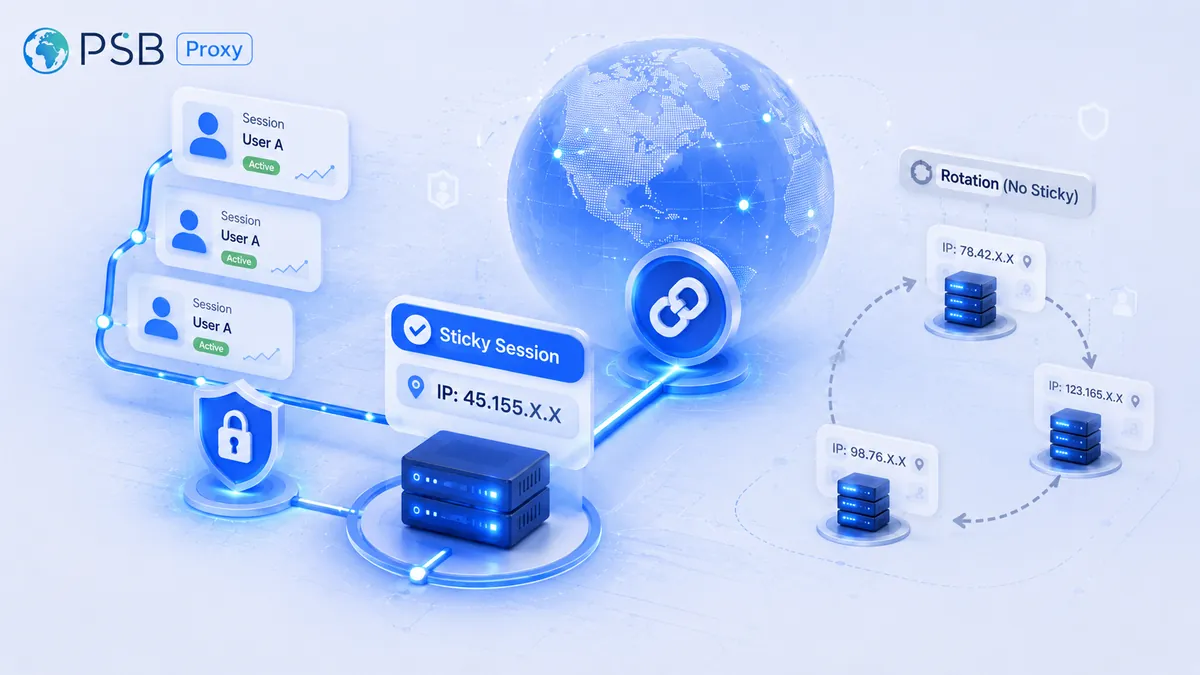
Two routing methods are used to solve such tasks. The first is the use of sticky sessions. This is a proxy mode in which a single IP address is assigned to a session for a specific period. The second is the use of IP address rotation.
Below, we’ll examine which of these methods is more appropriate in which scenarios.
How sticky sessions differ from IP rotation
Sticky sessions and IP rotation are two opposing approaches, each of which solves its own set of problems. Below are their specific differences:
| Aspect | Sticky session | IP rotation |
| How it works | A single IP is assigned to a session for a specified duration. | The IP changes after a request, based on a timer, a batch, or an event. |
| Duration | From 1 minute to 24 hours. | From 1 second to several minutes. |
| Primary purpose | Unified user context and cookies. | Load balancing and working with limits. |
| Secondary purposes | Accounts, authentication, forms, QA. | Parsing, data collection without authentication, bulk monitoring. |
| Blocking risk | Low with proper load and timing, but a single IP can be quickly overloaded. | The risk of losing a single IP is lower, but frequent “hopping” between subnets can disrupt the context. |
But let’s look at some real-world examples.
When working with 10 different accounts or separate browser profiles, you’ll still need a stable IP address throughout the entire work session. If it keeps changing, the algorithms might interpret this as suspicious activity and request a re-verification. So you can’t do without a sticky session here.
But if, say, you’re scraping competitors’ prices on a classifieds site by sending several hundred requests to product listings, you shouldn’t “stick” to a single IP—the platform will quickly hit the request limit. You need rotation.
How a sticky session works technically
To let the proxy server “know” that it needs to retain the IP, a special parameter is used—the session ID itself. In most services, it’s “embedded” directly into the proxy’s authorization string. For example, the format might look like this: username-session12345:password@ip:port. All requests sent from the aforementioned session12345 will go through the same IP until the session’s time-to-live (TTL) expires or a new ID is generated.
Criteria for choosing between sticky and rotation
Before choosing a mode, it’s important to understand not the name of the technology, but the logic of the scenario. Usually, it’s enough to answer a few questions:
- Is authorization and maintaining a single account required?
- Is there a multi-step user flow: form, cart, payment, callback?
- Is reproducibility important for QA and error investigation?
- What is the expected volume of requests, and can the task be broken down into independent batches?
- Are there request limits on the site side, and how critical is the frequency of requests?
- Is a stable GEO, browser profile, and unified session context required?
When a sticky session is better than rotation
A sticky session outperforms rotation in the following scenarios:
- Working in personal accounts on websites – after authorization, the service may consider the IP as one of the security factors alongside cookies, tokens, the device, and behavioral signals. So, changing the IP address mid-session is highly likely to be interpreted by the system as suspicious activity: it may log you out of your account and require re-verification. A sticky session, on the other hand, maintains a single IP address throughout the entire session.
- Form submission – filling out applications or registering with subsequent confirmation technically consists of a sequence of POST requests linked by a server-side session. And if the IP address starts changing constantly during the process, the backend may reset the data, losing the token.
- Online store shopping cart and checkout – although e-commerce platforms often store the shopping cart in cookies and databases rather than always linking it to an IP address, the IP address is still important during the payment stage. Payment gateway anti-fraud systems may compare the IP address from which the cart was filled with the IP address from which the transaction is being made. Therefore, IP rotation during the payment stage increases the risk of additional verification, session reset, or payment gateway rejection. A sticky session helps maintain a consistent context.
- Consistent user flow – for example, verifying the flow from logging into the account to submitting a request, making a payment, confirming via email, or proceeding via a callback. Here, it is important to maintain a single IP and a single context throughout the entire flow.
- QA and testing – testers absolutely need reproducibility. To achieve this, the user must follow the same scenario from a single IP address so that a bug can be isolated and reproduced.
- Authentication – both 2FA and callback redirects assume that the initiating and final requests will come from a single consistent context, so changing the IP address between steps can trigger security mechanisms.
When rotation is better than sticky session
Using IP rotation is more appropriate in the following scenarios:
- Mass parsing – for example, collecting prices and reviews from a large number of pages. Here there are no sessions, and each request is independent. IP rotation by request, by time, or by batches helps distribute the load across the proxy pool and reduces the risk of restrictions on a single address.
- Search engine results parsing and SEO monitoring – search engines may restrict unnaturally frequent automated requests. Rotating mobile or residential IPs helps collect site rankings and reduces the risk of restrictions when the request frequency is appropriate.
- Monitoring large data sets – tracking domains, job listings, advertisements. In such cases, tasks are broken into batches and distributed across the proxy pool.
- Independent requests – when each request does not depend on the previous one and does not require preserving cookies, tokens, or form state.
- Environments with request limits – when it is important to distribute requests across an IP pool and not overload a single address.
- Background data collection – ETL jobs, systematic metric collection, and content indexing are all tasks where throughput and stability of execution are more important than preserving a single user journey. If one proxy fails, the next request will go through another. And all this – without losing context, because there was no context to begin with.
What to choose for different tasks: sticky or rotation
- Login to a personal account – sticky, because a stable IP and a unified authorization context are needed.
- Multi-step form – sticky, because it is important not to lose tokens and cookies between steps.
- QA of user journey – sticky, because the scenario must be reproducible.
- Mass parsing of public pages – rotation, because the requests are independent and easy to distribute across the pool.
- Monitoring a large number of pages – rotation, because scale and throughput are important.
- Parsing with authorization – sticky, because changing IP in the middle of a session may trigger re-verification.
- Mixed project – combine both modes: sticky for authorization and long scenarios, rotation for background collection and independent requests.
How to choose sticky session duration
Choosing the timing for a sticky session is essentially always a compromise between convenience, security, and ordinary traffic savings. A session that is too short can lead to a connection break, while a session that is too long can lead to holding an IP for too long and increasing the risk of restrictions if the address has a bad reputation.
Nevertheless, there are several duration options. Each is more or less suitable for different situations:
- Micro-sessions (approximately 10 minutes each) – the optimal choice for checkouts, registrations, or submitting a couple of forms.
- Standard sessions (approximately 30–120 minutes each) – this duration works well for manual work in personal accounts, QA, and parsing internal APIs.
- Long sessions (2–12 hours each) – a good choice for working with advertising accounts and long scenarios with authorization.
Important: The session TTL for most providers is static. That is, it is counted from the moment the session is created and is not extended by subsequent requests. So if, for example, you set TTL to 30 minutes and make the last request at the 29th minute, after one minute the session will still expire and the IP will change. Therefore, it always makes sense to choose TTL "with a margin" to ensure you cover the time interval. What is also interesting – some providers offer so-called sliding TTL, where the session time is extended with each new request. This eliminates the need to take extra time as a reserve.
Mistakes when choosing sticky session and rotation
Incorrect configuration of either sticky sessions or IP rotation can lead to restrictions, errors, or scenario failure. Below are the main mistakes when working with both. Let's start with sticky sessions:
- Session break during execution – while performing a target action (filling a cart, going through checkout, filling out a form, etc.), if the sticky session time expires, the site will see that the user started the action with one IP and finished with another. To the system, this may look like suspicious context change. The result – the action may be canceled and access restricted. To avoid session break, it is better to use sessions tied to a session ID rather than just time, or increase the TTL itself.
- Getting stuck on an IP with a bad reputation – when initiating a sticky session, you may get an address that is already on blacklists or has a low trust score. After being attached to such an IP, CAPTCHAs or 403/429 errors will constantly appear. Traffic will be wasted. To prevent this, you can configure automatic session restart (generating a new session ID) when receiving the above-mentioned codes.
As for mistakes with IP rotation, these usually involve:
- Changing IP without clearing cookies – cookies and cache are saved from the previous IP. So even when rotating proxies, the site will be accessed with essentially the same data, which can become a signal for internal systems. A solution could be stable binding: 1 profile per 1 proxy or per one sticky session.
- Changing IP with every request – in this case, the site will see that one account is "jumping" across hundreds of different IPs, doing so unnaturally quickly. For accounts, it is better to use residential or mobile proxies with automatic time-based rotation, for example every 5–10 minutes, or the same sticky sessions if the scenario requires a single context.
- Ignoring ASN and subnets – if the proxy provider rotates IPs but they all remain within the same ASN, the site may restrict not a specific IP but the entire subnet – all subsequent rotations will be useless. The solution is to use proxies with a diverse ASN pool so that new IPs do not look like the same source.
- Mismatch between fingerprint and GEO – another common mistake during rotation. You may get a new IP from country A, but if you do not change the time zone accordingly, the security system may notice the desynchronization and restrict the session. Therefore, IP rotation should be accompanied by synchronization of the browser's geo-profile whenever possible.
What to do if both sticky session and rotation are needed
There are cases where both sticky sessions and rotation are required for the task. That means you will need a service that supports both modes. But beyond that, when choosing, you should also pay attention to other factors:
Selection Checklist
- Flexible duration settings – the ability to set TTL in a wide range (from one minute to a day or more) is a huge advantage.
- API management – the ability to dynamically change IP, set session ID, and control session parameters is another strong argument in favor of choosing a particular service.
- Large and high-quality IP pool – ideally, there should also be the ability to choose residential, mobile, and datacenter proxies for different tasks. The more diverse the pool and the clearer its geography, the easier it is to choose the right mode for a specific scenario.
- Geotargeting – the ability to select IP addresses from specific countries, cities, and providers is another big plus.
- Traffic and concurrent connection control – to see usage, success rate, and load per project.
- Test run on a small sample – to test sticky and rotation modes before scaling.
One proxy service for different scenarios
For work projects, it is better to choose a provider in advance that supports both modes — both sticky sessions and rotation. For example, in our PSB Proxy service, this approach can be used for different parts of a single task: sticky sessions for authorization, personal accounts, forms, and QA scenarios, and rotation for mass data collection, search result monitoring, and independent requests.
This format is especially convenient when a project cannot be clearly assigned to just one type. The same process may have a login stage where a stable IP is important, and a background data collection stage where rotation is needed. If the service allows you to manage these modes, it is easier not to break the project architecture and not to create multiple different solutions for adjacent tasks.
The main point
The choice between sticky sessions and IP rotation is not so much about "what is better or worse" but about matching the tool to the goals.
Sticky sessions are indispensable wherever preserving a single state is required. This includes working in personal accounts, checkout, QA of user journeys, and form filling. Their essence is that they help maintain a stable context: cookies, tokens, form steps, and authorization state.
Rotation, on the other hand, is more about volume. It is needed when you are going to parse search results, collect metrics, and scrape data. In other words, tasks where priority is given to throughput and distributing load across an IP pool.