

 Русский

 March 10, 2026
When a project starts to grow, the first question owners ask is how to choose hosting and whether current resources are enough for scaling.
But there’s a second, equally important question:
What kind of IP environment is your project operating in?
Many people think it’s enough to simply upgrade the server plan. In reality, stable infrastructure for scaling consists of two layers:
- Computing power (server / hosting)
- IP environment (reputation and trust from platforms)
Let’s break down what truly matters more—and how to avoid common mistakes when the load increases.
Why choosing hosting is a key stage in a project’s development
If you’re looking for how to choose hosting for a digital project, it’s important to understand: the server is the foundation of the whole system.
The server runs:
- a website or landing pages
- a tracker
- databases
- anti-detect browsers
- automation
- API integrations
If the server is weak or unstable, you’ll get:
- high response time
- delays in data processing
- connection errors
- traffic loss
- lower conversion rates
As the load scales, requirements increase:
- powerful AMD or Intel CPUs
- NVMe drives
- fast network connectivity
- unlimited traffic
- stable uptime
- fault-tolerant data centers
For example, PSB.Hosting’s server infrastructure is built on modern hardware and located in Tier III+ data centers—critical for projects where every minute of downtime is direct financial loss.
But even the most powerful server won’t protect a project if the IP environment is unstable.
Clean IPs for advertising: the hidden factor behind bans
If you work with advertising platforms, marketplaces, or accounts, the IP address becomes part of your reputation. That’s why the query “clean IPs for advertising” is becoming increasingly relevant.
Problems arise when an IP:
- is located in a “noisy” data center
- is shared by many users
- has a negative history
- changes frequently without a clear pattern
In this case, even with a perfect server, you may face:
- account restrictions
- extra verification checks
- reduced trust from platforms
That’s why infrastructure should be separated: the server handles computing, the IP handles the connection environment.
Comparison table: hosting vs. IP environment
| Parameter | Powerful hosting | Clean IPs for advertising |
|---|---|---|
| Responsible for | Performance and computing | Connection reputation |
| Affects | Site speed, APIs, databases | Account stability |
| Solves | Latency and overload | Bans and restrictions |
| Critical during | Traffic and load growth | Scaling accounts |
| Risk when cutting costs | Speed drops | Account loss |
As you can see, these elements don’t compete—they complement each other.
Infrastructure for scaling: the right architecture
If the goal is sustainable growth, it’s important to build scalable infrastructure, not just upgrade the plan.
A modern architecture looks like this:
- High-performance server
- Role separation (server = logic, IP = environment)
- Scalable IP infrastructure
- Load monitoring and control
On the server side, you need:
- resource headroom
- a stable network channel
- minimal latency
On the IP side, you need a natural and predictable environment.
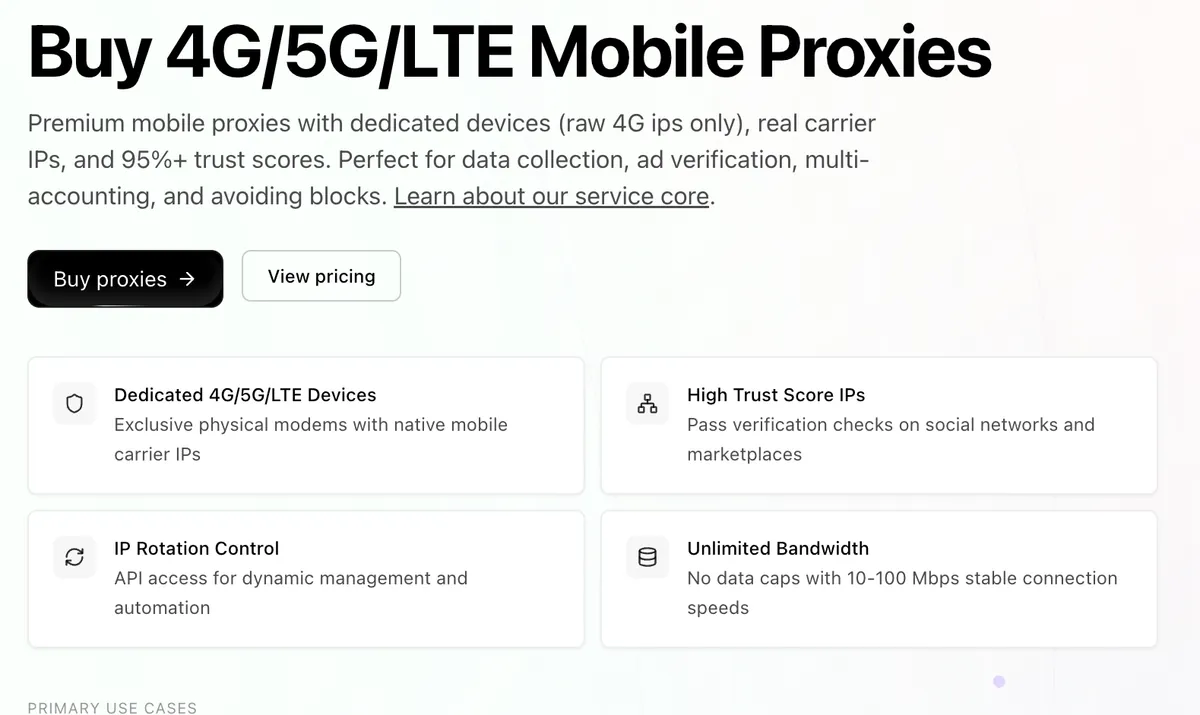
In practice, for tasks related to scaling accounts, many teams use mobile IP infrastructure with real 4G/5G addresses. These solutions look the most natural to advertising system algorithms.
For example, mobile IP services like Coronium.io allow you to build a separate IP-environment layer without loading the server side or mixing roles.
The server remains the computing center (e.g., on PSB.Hosting), while the IP infrastructure works as an external connectivity layer. This separation is what makes the system resilient.
How to choose hosting if you plan to grow
If your project is planning to scale, consider the following when choosing hosting:
- the ability to upgrade quickly
- no traffic limits
- stable uptime
- technical support
- placement in reliable data centers
Choose hosting not “for today,” but with room for growth.
Common infrastructure mistakes
Mistake 1: upgrading the server while ignoring IP
If accounts are getting restricted, the server won’t fix it.
Mistake 2: changing proxies when the issue is an overloaded server
If the site is slow, it’s about resources—not IP.
Mistake 3: building everything on one plane
Mixing server tasks and IP functions makes the system less predictable.
What’s more important—hosting or IP?
Honestly, you can’t choose just one:
- Hosting provides power
- The IP environment provides trust
- Together they create resilience
A powerful server without clean IPs means stable computing with unstable accounts.
Clean IPs without a stable server means good reputation with technical failures.
For long-term growth, architecture is what matters.
FAQ
How do I choose hosting for a project with ad traffic?
Consider performance, network connectivity, and scaling ability. Also separate the server side and IP infrastructure.
Is it enough to just upgrade the server plan?
No, not if the problem is related to IP reputation.
Do I need clean IPs for advertising?
Yes, if you work with accounts and advertising platforms.
Can I combine server and IP in one place?
Technically yes, but for resilience it’s better to separate infrastructure layers.