

 Русский

 June 4, 2026
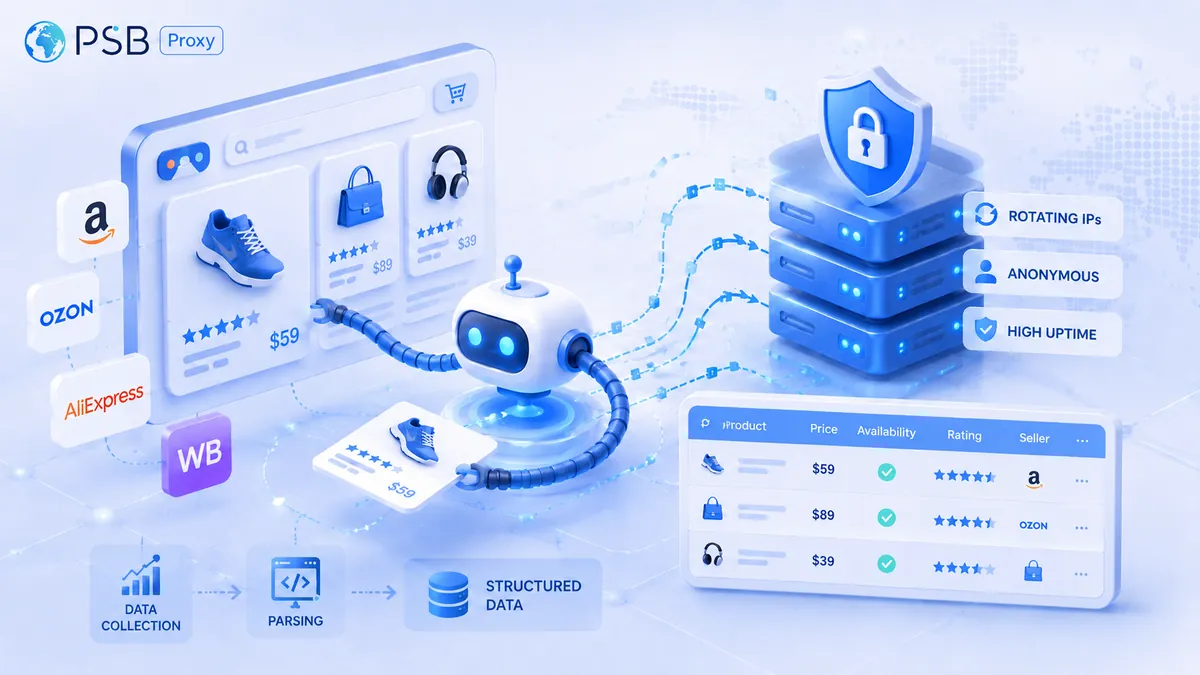
Online stores, analytics services, and advertising agencies often collect information from e-commerce platforms using specialized data-parsing software. Parsing data from WB, Ozon, and other major marketplaces enables businesses to address a variety of challenges, ranging from automated price monitoring and demand analysis to assessing competitors’ activities. If proxies are selected and used correctly, you can collect data from the desired regions more reliably, distribute the load, and reduce the risk of restrictions imposed by the marketplaces’ security systems.
 What Data Is Collected on Marketplaces
Main Types of Data
Marketplaces contain a vast amount of information, and different types of data require different approaches to collection. Most often, companies collect:
- public product listing data: names, specifications, images, categories;
- prices, discounts, stock levels, and shipping terms;
- product rankings in search results and popular collections;
- seller data from public profiles, ratings, and terms of service;
- customer ratings and reviews;
- data on promotions and discounts.
How the type of data collected affects proxy selection
The choice of proxy depends on the type of data being collected, as website algorithms employ different levels of protection. For example, scraping products from Ozon and Wildberries often requires rotating residential IPs to ensure stable data collection and reduce the risk of restrictions. Verifying accurate regional prices requires strict geotargeting. If a smartphone or tablet is used to collect information, mobile proxies are suitable. They use IP addresses from mobile network operators (3G, 4G, LTE, 5G). Comprehensive collection of search results, product listings, and ad placements, which requires maximum credibility, is impossible without high-quality residential proxies.
What Factors Determine the Choice of Proxies for Marketplaces
When selecting the optimal proxy for working with marketplaces, you should consider the following factors:
- Parsing scale. The number of requests is one of the key factors in choosing a proxy. If you need to make up to 1,000 requests per day, you can use a data center proxy. For larger volumes (from several thousand to millions), you will need residential IP rotation.
- Platform sensitivity. Small local marketplaces are relatively tolerant of automated traffic when the request frequency is appropriate. Individual IPv4 server proxies are sufficient for data collection. Large international marketplaces typically use powerful anti-fraud systems that detect data center IPs. In this case, mobile or residential proxies are used.
- Data regionality. Marketplaces display different prices, delivery terms, and product availability depending on the buyer’s geolocation. If you need to parse prices on marketplaces for a specific region, you should use proxies with precise geotargeting from the provider’s pool.
- Environment type. Marketplaces may return different layout structures (HTML for web browsers and JSON-API for mobile apps). If the parser operates via a web interface, high speed and proper User-Agent configuration are essential. For mobile contexts, mobile proxies can be used. In this case, request headers will match traffic from smartphones and tablets running on iOS/Android.
You should also pay attention to session duration. Short sessions are suitable for bulk collection of catalogs, reviews, or prices. In this case, a proxy with automatic pool rotation will be required. Long sessions (from 10 minutes to several hours) are suitable for platform authorization and working with a seller’s personal account. For such scenarios, residential and mobile proxies are more commonly required.
When data center proxies are suitable for marketplaces
Data center proxies are the most affordable and fastest option. They are located in data centers and are not associated with users’ actual home devices. These IPs are easily scalable and provide high connection speeds. Such proxies are primarily used for:
- quick setup;
- mass price monitoring;
- basic product listing collection;
- working with less secure platforms;
- projects with a limited budget.
Currently, many large marketplaces can quickly identify datacenter IPs through ASN, behavioral analysis, and reputation databases. For complex parsing, datacenter proxies alone are often insufficient.
When Should You Choose Resident Proxies as Your Primary Option
Resident proxies use the IP addresses of regular home users. To anti-bot systems, this traffic appears as natural as possible. These proxies are effective for:
- crawling search results;
- large-scale monitoring;
- working with request limits;
- regional scraping;
- working with automation-sensitive platforms;
- long-term projects.
For most commercial tasks, residential proxies are the primary tool of choice today.
When to use mobile proxies
Mobile proxies are considered among the most reliable, as their IP addresses belong to real mobile network operators. For anti-fraud systems, strictly restricting mobile IP addresses is more difficult: along with suspicious traffic, restrictions may affect regular subscribers. Mobile proxies are not always necessary. It makes sense to use them when:
- working with mobile apps;
- scraping mobile APIs;
- parsing mobile search results;
- analyzing mobile advertising;
- implementing complex anti-bot protections.
If you need to parse Ozon prices for routine monitoring, using mobile proxies is often not cost-effective. They are significantly more expensive than residential and data center proxies.
Comparison of 3 Types of Proxies for Marketplaces
| Type | Cost | Reliability | Speed | Scalability | Geo | Mobile | When to Use | When Not to Use |
| Data Center Proxies | Low (often a fixed price per IP) | Low. IPs from data centers are quickly identified and restricted by anti-bot systems | Very high | Excellent | Poor. IPs are tied to server racks, limited selection of countries/cities | None (traffic comes from data center wired networks) | Quick start, parser testing, high-volume technical requests | If the platform strictly filters data center IPs or precise GEO data is required |
| Residential | Medium/High | High. Home network traffic appears natural | Medium (depends on the home user’s connection) | High, convenient for parsing any volume | Excellent. Huge selection of locations down to the city or ISP level | Partially (traffic is identified as home ISP) | Regular collection of listings, prices, reviews, and search results, regional checks | If you only need a cheap technical test without stability or GEO requirements |
| Mobile | Very high | Very high. IPs are shared among many subscribers, so websites rarely impose strict limits on them | Average/low | Average; pools of high-quality addresses are expensive | Depends on the carrier. Usually selected by country/region; the provider assigns a dynamic IP from a pool | Excellent (4G/5G traffic from mobile carriers) | Mobile delivery, app/API scenarios, complex anti-bot filters | If the task is routine price monitoring across a large number of SKUs and the budget is limited |
Each type of proxy has its own characteristics and advantages for data collection on e-commerce platforms.
Which Proxies to Choose for Different Marketplace Parsing Scenarios
Daily price monitoring for a large number of SKUs
For this task, a combination is often used:
- data center proxies;
- residential proxies for more complex requests.
If the marketplace isn’t too restrictive, data center proxies are sufficient.
Stable collection of product listings and results
In this case, residential proxies are the best choice. They provide:
- stability;
- a low rate of restrictions;
- good scalability;
- high-quality IP rotation.
If you need to scrape Avito, Ozon, or another platform using residential proxies, you can more accurately check regional search results and reduce the risk of IP-based restrictions.
Checking data by region
Residential proxies with wide coverage are ideal for geo-targeting tasks. Some projects require:
- a specific city;
- a region;
- an ISP;
- an ASN;
- a local carrier.
Data center proxies are inferior to residential proxies in terms of effectively solving geo-tasks.
Mobile search results and mobile context
We recommend using mobile proxies if you need to analyze:
- mobile apps;
- mobile search;
- app APIs;
- mobile advertising.
Regular IPs may provide inaccurate data or are more likely to encounter restrictions.
Quick start with a minimal budget
In the early stages, data center proxies are the most affordable option. They allow you to:
- test a hypothesis;
- test a parser;
- assess the extent of restrictions;
- quickly launch an MVP.
In later stages or when working with complex web resources, you will still need to use more expensive residential proxies.
How to Evaluate the Value of the Outcome, Not Just the Price of the Proxy
Many companies make the mistake of focusing solely on the price of the proxy. However, it is important to evaluate the total cost of successful data collection. Cheap proxies can lead to lost requests, mass restrictions, increased parsing time, and resource overuse. As a result, more expensive residential proxies may prove more cost-effective due to:
- fewer errors;
- a higher success rate;
- consistent collection speed;
- reduced load on infrastructure.
Even with higher costs, residential proxies can deliver tangible benefits due to the high level of trust they command from anti-fraud systems and search algorithms.
How to Choose a Proxy Service for Marketplace Parsing
Selection Checklist
To perform Ozon review parsing, price monitoring, product listing collection, and regional search result verification, a proxy service must provide:
- a low rate of restrictions;
- geo-targeting;
- a large IP pool;
- stable rotation;
- an API for automation;
- transparent statistics;
- choice of proxy type: data center proxies, residential, or mobile;
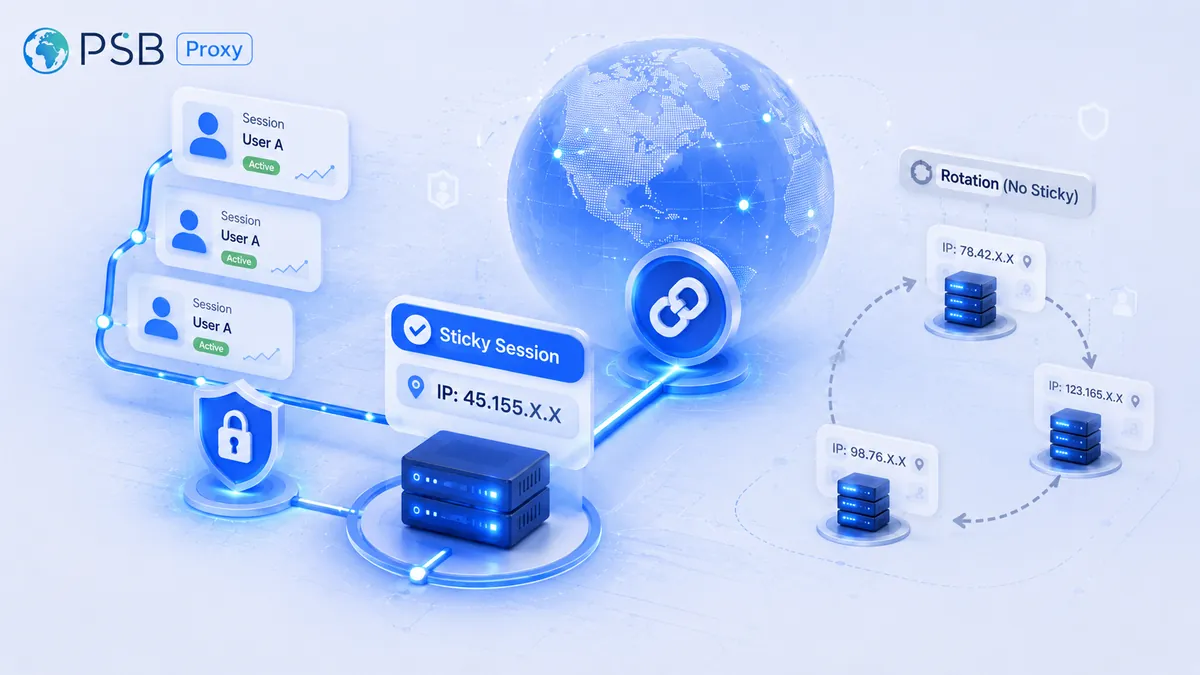
- fixed sessions and configurable rotation frequency;
- traffic control and clear pricing;
- support, documentation, and API access.
Mistakes When Choosing Proxies for Marketplace Scraping
Choosing the wrong proxies for marketplaces leads to unstable data collection, an increase in restrictions, data errors, and unnecessary infrastructure costs. Common mistakes:
- Buying the cheapest proxies or using free ones. Thousands of people use them, so such addresses are often already blacklisted by marketplace security systems.
- Lack of rotation. To collect large volumes of data, you need mobile or residential proxies with automatic IP rotation; otherwise, a single address will quickly face restrictions or captchas.
- Ignoring geographic factors. Marketplaces heavily personalize search results by region.
- Choosing mobile proxies for every task. They aren’t always necessary and can be too expensive for routine price monitoring.
- Ignoring the differences between web and mobile contexts. Web results, mobile apps, and app APIs may return different data.
- Evaluating price alone. It’s important to consider the success rate, the cost per successful request, and the stability of the results.
- Failing to test on a small sample. Before scaling up, it’s best to test the proxies on a specific platform, region, and data type.
In conclusion
The choice of proxies for scraping marketplaces such as Ozon, Wildberries, and other platforms affects the stability of data collection, the rate of rate limits, and the final cost of the project. Data center proxies are suitable for simple and inexpensive tasks where speed and scalability are important. Residential proxies are in demand due to their stability and natural traffic profile. Mobile proxies are needed for mobile contexts and complex anti-bot systems.