

 Русский

 January 4, 2026
In the era of total platform control over user behavior, a proxy server is no longer just a tool for bypassing regional restrictions. Today, it is the foundation of security in traffic arbitrage, data scraping, and managing hundreds of accounts. Choosing the wrong type of proxy can cause technical failures and lead to financial losses due to blocked ad accounts and lost profiles that require long and costly warm-up periods. That is why it is important to understand which proxy type and country should be used for specific tasks.
| Task | Proxy Type | Country | Comment |
|---|---|---|---|
| Telegram, Instagram, VK | Mobile 4G/5G | Account registration country | Telegram and other social networks trust mobile IPs the most, as thousands of real users access the internet from a single mobile operator IP. |
| WhatsApp (including Business) | Mobile | SIM card country | WhatsApp algorithms compare the phone number country code with the IP geolocation. A mismatch can result in a ban within an hour. |
| YouTube, Netflix | Datacenter (IPv4) | USA, Germany, Turkey | YouTube requires high bandwidth. Datacenter proxies provide speeds from 100 Mbps, which is critical for 4K video streaming. |
| Traffic arbitrage / Advertising | Residential / Mobile | USA, United Kingdom, Canada | These countries have the highest Trust Score. Accounts last longer and moderation processes are more predictable. |
| Mass data scraping | Rotating residential | Worldwide | Allows simulation of traffic from different cities, bypassing anti-bot protection and request limits. |
| Crypto exchanges, fintech | Static residential | KYC verification country | Crypto platforms such as Binance and Bybit may trigger account restrictions when IP addresses change, requiring a consistent residential location. |
Why the country and IP type are critically important
Anti-fraud systems rely on specialized databases that are updated daily. A key parameter in this process is the Autonomous System Number (ASN). ASN identifies the autonomous system that owns a specific IP address and allows websites to understand who controls that IP.
The importance of the country and IP type is explained by several factors:
- Geographic factor.
It is often not enough to use an IP from a specific country — in many cases, the IP must belong to a particular state or even a city. Accurate local GEO helps bypass regional filters that may block requests even from neighboring states. - Data center ASN.
If a website detects that a user is connecting from servers owned by providers such as Amazon Technologies, the level of suspicion increases automatically. For banks or payment systems, this can trigger an immediate transaction block. - Residential ISP ASN.
When an IP belongs to a residential provider like Comcast or Vodafone, anti-fraud systems classify the user as a regular consumer. In such cases, minor behavioral anomalies are more likely to be tolerated.
For this reason, using the correct IP with the appropriate country and ASN is critical to avoiding blocks or increased suspicion. An incorrect choice can lead to technical failures and account restrictions.
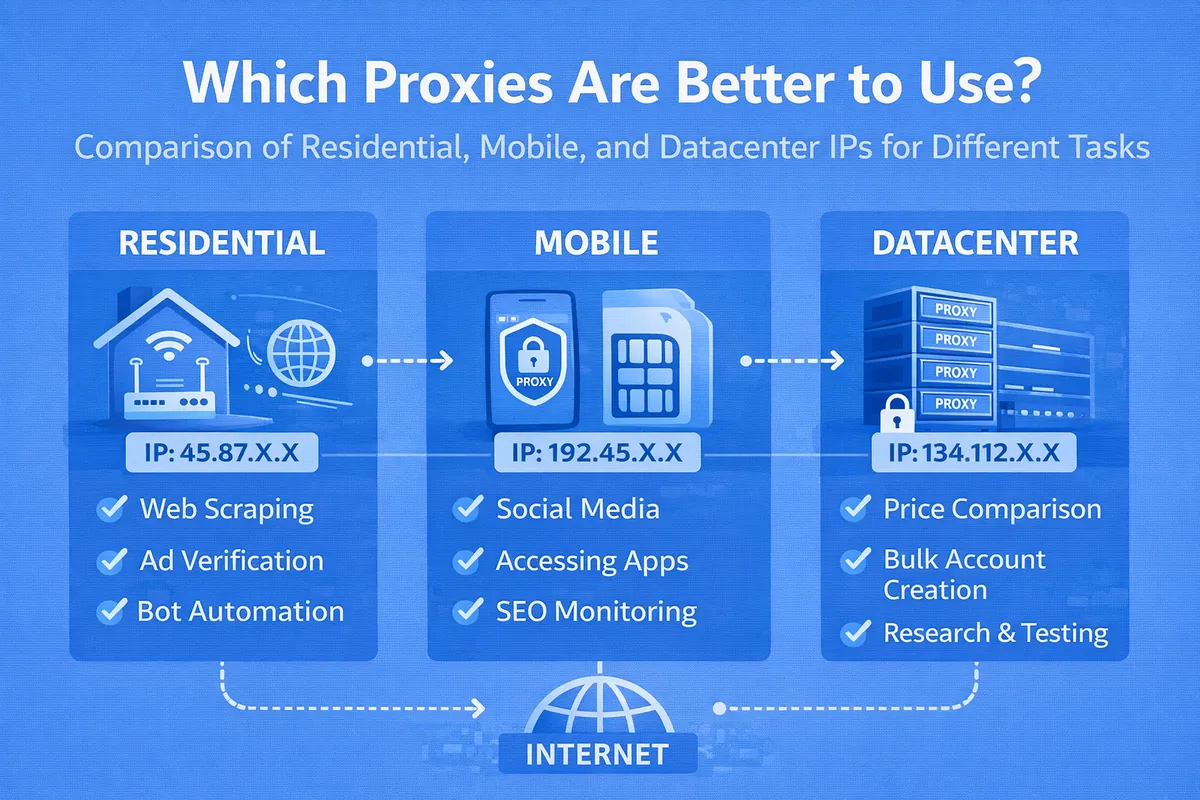
Detailed comparison of proxy types: residential, mobile, and data center IPs
To make the right choice, it is important to understand the specifics of each proxy type, their strengths, and their hidden drawbacks.
Data center IPs
These proxies are created on servers located in data centers. They are not associated with internet service providers that serve residential households. Proxy providers rent server capacity and allocate thousands of IP addresses. These are virtual addresses that exist only in the cloud.
Key advantages:
- the fastest proxies on the market with minimal ping;
- the most budget-friendly option, often with unlimited traffic;
- uptime close to 100%, as servers operate in controlled environments with backup power.
The disadvantages include the risk that if one user within a subnet violates a website’s rules, the administration may ban the entire IP range. In addition, the “data center” flag in IP databases immediately signals to a website that the visitor is a bot or a professional user.
Residential proxies
This is the optimal option for most parsing and multi-accounting tasks. These IPs belong to real people using home Wi-Fi connections. Providers build P2P networks that include millions of residential devices worldwide. When such a proxy is used, the request passes through the router of a real person.
Key advantages:
- for security systems, the user looks like a regular customer or website visitor;
- the ability to choose not only a country, but also a specific city or ISP;
- top providers offer pools of 30–100 million IPs, making large-scale blocking almost impossible.
However, if the real device owner turns off their router, the IP becomes unavailable. Providers solve this through automatic rotation. Residential proxies can also be expensive when working with video or heavy content.
Mobile proxies
This is the most powerful tool in the arsenal. These are IP addresses of mobile network operators. Mobile carriers use CGNAT technology. Since there are billions of mobile devices and a limited number of IPv4 addresses, operators assign the same IP to thousands of users simultaneously.
Key advantages:
- websites are reluctant to ban mobile IPs, as this could block access for thousands of real users at once;
- IPs can be changed via a link or on a timer, receiving a new address from the operator’s pool each time;
- high-quality mobile proxies transmit correct operating system fingerprints that match mobile connections.
The downside is that this is the most expensive type of proxy. In addition, if a mobile base station is overloaded, connection speed may temporarily decrease.
Comparative Table of Technical Parameters
| Parameter | Data Center | Residential | Mobile |
|---|---|---|---|
| Cost | Affordable | High | Medium |
| Speed | High | Medium, depends on node | Depends on 4G/5G signal |
| Anonymity | Low, easily detected | High | Maximum |
| IP Lifetime | Months | From 1 minute up to 24 hours | Rotation by link or timer |
| Traffic Limits | Usually unlimited | Charged per GB of traffic | Usually unlimited per port |
| Subnet Cleanliness | Often spammed | Clean | Very clean |
Typical Mistakes and How to Avoid Them
There are several common mistakes when choosing proxy servers. Following a set of basic rules helps to avoid them.
Mistake 1: Saving on proxies for business tasks
Many beginners buy a package of 1,000 data center IPs at a minimal price to work with Facebook. This often leads to Meta’s algorithms detecting that all 1,000 IPs belong to the same server rack. As a result, the entire account farm gets banned after the first activity. To avoid this, mobile proxies should be used for registration and farming. They are more expensive, but the return on investment is higher due to better account longevity.
Mistake 2: Geo mismatch
Using a US proxy while the browser language is set to Russian and the time zone is UTC+3. This is an instant trigger for security systems. To prevent this, it is recommended to use anti-detect browsers. They automatically adjust hardware parameters, language, and time settings to match the geo of the proxy.
Mistake 3: Ignoring rotation during parsing
Trying to collect 50,000 product cards from Amazon using the same residential IP. After 20–30 fast requests, the IP may be added to a grey list, resulting in captchas or empty responses. To solve this issue, automatic IP rotation should be enabled. For large-scale parsing, residential networks with traffic-based billing are ideal, where each new request goes through a new IP from a pool of millions of addresses.
Conclusion
Choosing proxies is not about which type is better overall, but about selecting the optimal option based on risks and budget. Therefore, consider the following:
- for streaming, file downloads, and simple “white” websites, inexpensive data center IPs are ideal;
- for traffic arbitrage and working with Google Ads and Facebook, mobile proxies are critical for account management, while residential proxies are needed for scaling;
- for parsing and market research, the best choice is residential proxies with rotation.
High-quality proxies act as business insurance. Trying to save $20 on proxies often results in losing $200 invested in accounts and content. Therefore, it is not worth cutting costs on quality proxies when they are used for business purposes.