

 Русский

 October 23, 2025
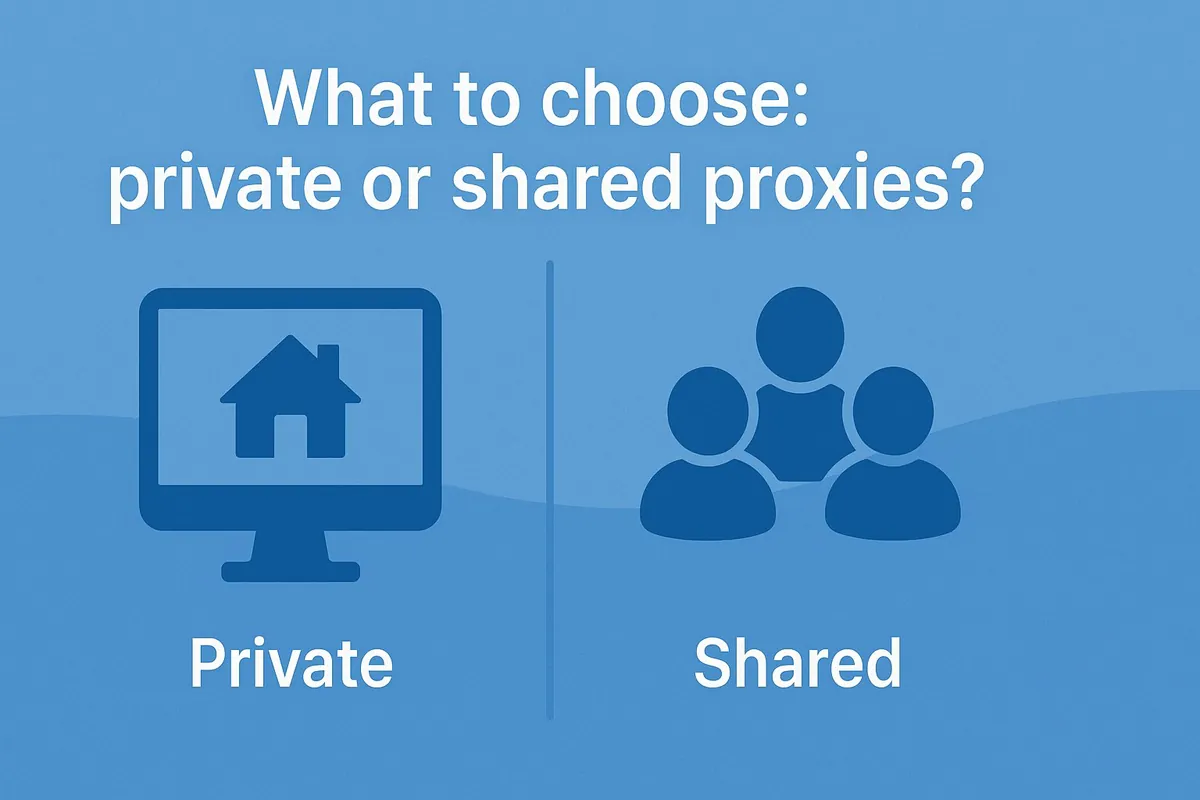
It’s hard to imagine today’s internet without data protection, anonymity, and a stable connection. To achieve this, users increasingly turn to proxy servers. Proxies help hide your IP address, bypass blocks, and keep online activity secure. But when choosing a proxy, a key question arises: which is better - private or shared? Below, we explain how they differ, where each is used, and how to pick the right option for your needs.
What are private (dedicated) proxies?
Private proxies (also called dedicated proxies) are servers allocated exclusively to a single user. They give you full control over the connection, provide stable speeds, and minimize the risk of blocks. This makes them especially useful for managing multiple accounts, automating workflows, data scraping, and advertising campaigns. Private proxies offer a high level of confidentiality and security, making online operations more predictable and reliable.
Key features
The main qualities that make private proxies valuable and in demand are:
- A dedicated IP address not shared with others.
- High speed and stable connectivity.
- Minimal risk of blocks and blacklisting.
- Full anonymity and security.
These traits make private proxies the optimal choice for users who prioritize a stable, secure connection - without worrying that someone else’s actions will slow them down or trigger blocks.
Use cases
Private proxies are in demand for:
- Working with marketplaces and data scraping.
- Managing multiple social media accounts.
- Automating advertising and SEO analytics.
- Online purchases and bookings.
Private proxies create highly predictable operating conditions online - especially valuable for automation, marketing, and multi-account management. In short, they suit users who value reliability and need maximum control over their connection.
What are shared proxies?
Shared proxies are servers used by multiple users at the same time. They cost less than private proxies and suit tasks that don’t require high speeds or full control over the connection. Shared proxies let you hide your IP, bypass basic blocks, and perform simple online actions without major resource or budget outlays.
Key features
- A single IP address may be used by several people.
- Potential instability due to overload.
- Higher risk of temporary blocks during heavy activity.
- Significantly lower cost than private options.
These traits make shared proxies a practical choice for users on a tight budget or for tasks where only basic anonymity and IP rotation are needed.
Use cases
For many users, shared proxies are a convenient, affordable way to switch IPs quickly and handle everyday online tasks without major expense. They’re suitable for simple services, testing, and one-off operations where high speed or full confidentiality isn’t required. Typical scenarios include:
- One-time tasks and infrequent use.
- Mass registrations that don’t require strong protection.
- Service testing and basic geo-access checks.
- Educational or lab purposes.
Thanks to their accessibility and simplicity, shared proxies remain popular with newcomers and cost-conscious users who need fast IP changes without complex setup.
Comparing private vs. shared proxies
To clearly highlight the differences, here are the key characteristics side by side:
| Criterion | Private proxies | Shared proxies |
|---|---|---|
| Access | One user only | Multiple users |
| Speed | High, stable | May drop under load |
| Security | Maximum, minimal leak risk | Moderate, depends on other users |
| Price | Higher | Lower |
| Blocks | Minimal risk | Possible |
| Typical use | Business tasks, scraping, advertising | Light or temporary tasks |
Private proxies deliver maximum performance and confidentiality; shared proxies are suitable when cost savings are the main priority.
When to choose private proxies
Using private proxies makes sense when:
- you need stable 24/7 operation;
- you run multiple ad campaigns or social media accounts;
- preventing account bans is critical;
- you handle confidential data or do scraping.
For businesses, freelancers, and agencies that prioritize quality and security, private proxies are the best choice.
When to choose shared proxies
Shared proxies are a sensible choice when tasks are limited by time and budget:
- you need to test a service or website;
- you only need a temporary IP change;
- your request volume is low;
- long-term stability isn’t required.
They’re a good fit for newcomers and users who need to minimize costs.
Where to buy private and shared proxies
When choosing proxies, focus on reputable providers with stable infrastructure.
Top 5 providers (as of 2025)
- PSBProxy – A modern service offering a wide range of private and shared proxies for any purpose. High speeds, reliable data centers, 24/7 support, flexible pricing, country selection, and integrations with popular tools.
- Proxy-Sale – A stable provider suitable for basic tasks.
- SmartProxy – An international provider with a large IP pool.
- Proxy6 – Known for affordable shared proxies and IPv6 support.
- BuyProxies – A foreign option with a strong focus on SEO and scraping.
Before choosing a service, weigh the pros and cons and read genuine user reviews.
How to choose
When selecting a provider, pay attention to:
- the number of available IP addresses and countries;
- connection types (HTTP, HTTPS, SOCKS5);
- support for required geolocations;
- server speed and stability;
- anonymity level and the option to rotate/replace IPs.
If you need a balance of speed, reliability, and privacy, PSBProxy remains an optimal choice - it combines the flexibility of shared options with the power of private proxies.
Can you get private proxies for free?
Of course, many would like to get private proxies at no cost—but there are several important factors to consider.
Risks
Free “private” proxies are often advertised online, but using them is highly risky. Key threats include:
- a high likelihood of personal data leaks;
- traffic being routed through insecure servers;
- unstable connections and low speeds;
- the possibility of surveillance or malicious activity.
Remember the old saying: there’s no such thing as a free lunch. Even top-tier providers aren’t so expensive that it’s worth cutting corners here.
Alternative
Instead of dubious free options, choose paid shared or private proxies from providers with a clear, trustworthy reputation. Many vendors - including PSBProxy - offer trial periods and flexible pricing, allowing you to safely test their service without overpaying.
The choice between private and shared proxies depends on your tasks and priorities. If you need speed, security, and reliability, private proxies are the right fit. If you only need temporary anonymity on a tight budget, shared proxies will do.
In all cases, it’s best to rely on reputable providers that deliver high-quality connections and transparent terms. Among Russian services, PSBProxy deservedly holds a leading position: it combines technical stability, modern infrastructure, and a strong user focus - an optimal option for those who value control, security, and efficiency online.